POWER AND FRAGILITY: THE PARADOX OF CAL KESTIS IN JEDI: SURVIVOR
Here is the deep-dive analysis of Star Wars Jedi: Survivor, focusing on the conflict between power mechanics and narrative vulnerability, with the numbering removed from the headings as requested.
POWER AND FRAGILITY: THE PARADOX OF CAL KESTIS IN JEDI: SURVIVOR
In the world of video games, character progression is a standard trope. However, with Star Wars Jedi: Survivor, Respawn Entertainment created a deliberate friction: the more formidable Cal Kestis becomes in gameplay, the more exhausted and helpless he appears in the narrative. This is not merely a balance issue; it is a profound reflection of a lone Jedi’s status amidst the Empire's dark age.
This article explores the friction between the "Power Fantasy" and "Harsh Reality"—a recurring theme that elevates Survivor from a simple action game to a tragedy about growing up in a state of desperation.
The Legacy of the Padawan: From Bracca to Koboh
In Jedi: Fallen Order, players experienced a journey of reclamation. Cal Kestis began as a traumatized scavenger with a fractured connection to the Force. Mechanically, this justified a "Metroidvania" progression where basic abilities like Double Jump or Force Push had to be relearned. Cal’s vulnerability then was not just a game mechanic; it was his defining identity.
Entering Survivor, Respawn faced a creative challenge: how do you "reset" a character who has already reclaimed his Knighthood? Unlike many sequels that strip the protagonist of their powers through a convenient plot device, Survivor lets Cal keep his core kit. From the opening moments on Coruscant, Cal is a whirlwind of destruction. This shift changes the player's mindset—moving from a survivor in hiding to a commander leading a resistance.
The Shift in Power Dynamics
- Narrative Confidence: Cal no longer hesitates; his dialogue reflects a man who has fought Inquisitors and survived Vader.
- Mechanical Complexity: The introduction of five distinct stances immediately signals that the "apprentice" phase of Cal’s life is over.
The Lure of the Dark Side: Mechanics as Metaphor
As the story progresses, the game introduces the "Slow" mechanic, which eventually evolves into a devastating Dark Side outburst. This isn't just a "super move" for room clearing; it represents the central conflict of the game. Cal’s increasing power makes him more dangerous, not just to the Empire, but to himself. The game uses high-octane combat to make the player feel the seductive rush of being an unstoppable Force-user.
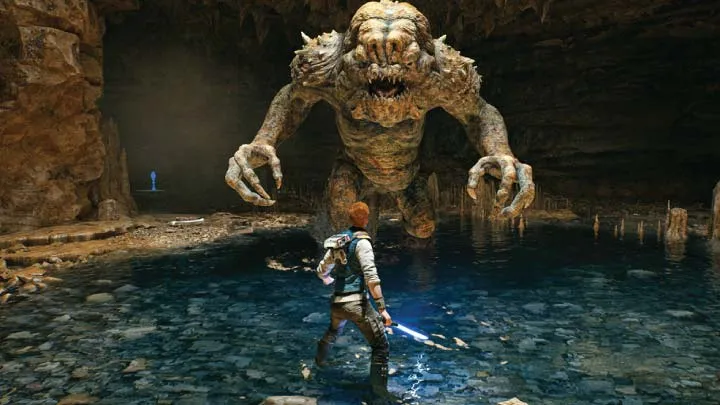
However, this creates a specific issue: when the player feels invincible during gameplay, narrative beats where Cal is sidelined or defeated can feel jarring. This "Power Paradox" is a recurring theme. We see a Jedi capable of taking down a Rancor with his bare hands, yet the script requires him to struggle against a lone antagonist like Rayvis or Dagan Gera to maintain dramatic tension.
The Stance System: Specialization vs. Versatility
One of the deepest mechanical additions is the Stance System. By forcing players to choose only two active stances at a meditation point, Respawn attempts to balance Cal’s overwhelming power. Whether it’s the defensive reliability of the Crossguard stance or the nimble, ranged utility of the Blaster stance, these choices define how the player interacts with the world.
This system serves as a metaphor for Cal’s search for identity. He is no longer just a "Jedi"; he is a warrior adapting to a galaxy that has outgrown the old ways. The Blaster stance, in particular, highlights the friction between Jedi tradition and the pragmatic reality of survival. Using a "civilized" weapon alongside a blaster shows a character willing to blur lines to achieve his goals.
Stance Breakdown and Utility
- Single: The classic balance of speed and power.
- Double-Bladed: Peerless crowd control for overwhelming numbers.
- Dual Wield: High-risk, high-reward offense representing Cal’s aggressive growth.
- Crossguard: Slow, heavy hitters for those who prefer "Soulslike" timing.
- Blaster: The ultimate sign of Cal’s departure from the High Republic ideal.
Environmental Friction: Why Can’t a Jedi Jump That?
A persistent issue in Survivor is the disconnect between Cal’s Force-enhanced mobility and the "invisible walls" of the game world. We see Cal perform incredible acrobatic feats in cutscenes, leaping hundreds of feet or slowing massive machinery. Yet, in exploration, he is often thwarted by a chest-high fence or a slightly steep incline that requires a specific "unlockable" ability to bypass.
This is the classic Metroidvania problem heightened by the Star Wars setting. When Cal gains the ability to dash through green laser barriers (Merrin’s Charm), it feels less like a natural evolution of his Force powers and more like a necessary "key" for a "lock." This mechanical rigidity often clashes with the fantasy of a Jedi who should, theoretically, be able to manipulate the environment with more creativity.
The Tanalorr Obsession: A Narrative Anchor for Power
The pursuit of Tanalorr serves as the perfect narrative counterweight to Cal’s combat prowess. No matter how many Stormtroopers he defeats, Cal cannot "fight" his way to a safe haven. Tanalorr represents an unreachable ideal, a place where his power wouldn't be needed for violence. This creates a dynamic where the player’s mastery of combat feels increasingly futile in the face of a galaxy that is fundamentally broken.
Cal’s struggle with Dagan Gera—a literal dark reflection of what a Jedi becomes when they lose sight of their purpose—illustrates this. Dagan is more powerful than Cal in the Force, yet he is undone by his obsession. This suggests that in the world of Survivor, "power" is not measured by lightsaber skill, but by emotional resilience. This deep thematic layer justifies why Cal remains "vulnerable" despite his growing list of abilities.
Boss Design and the Fairness of the Force
The boss encounters in Survivor are designed to test the limits of Cal’s power scaling. Battles against enemies like the Spawn of Oggdo or the legendary Bedlam Smasher are notoriously difficult, requiring frame-perfect parries. Here, the game abandons the "Power Fantasy" in favor of "Survival Reality." These difficulty spikes remind the player that even a Jedi Knight is one mistake away from death.
This creates a rhythmic tension in gameplay. You move from "God Mode" while clearing scout troopers to a "Survival Horror" mindset during boss fights. Critics argue this creates a disjointed experience, but it effectively mirrors the life of a fugitive. You are powerful, yes, but you are always outnumbered and hunted by things that are faster, stronger, and more relentless than you.
Key Combat Metrics
- Parry Window: Decreases significantly on higher difficulties (Grandmaster).
- Force Usage: Requires aggressive play to "recharge," preventing players from cheesing encounters with ranged Force moves.
The Role of Companions: Bode and Merrin
The addition of AI companions like Bode Akuna and Merrin adds a new dimension to Cal’s power. Mechanically, they provide assists—Bode with his jetpack and blasters, Merrin with her Nightsister magick. Narratively, they act as the "tethers" that keep Cal grounded. When Cal uses a "Team Takedown," it emphasizes that his greatest strength isn't individual mastery, but his ability to build a family.
However, the betrayal of Bode Akuna flips this mechanic on its head. The person who amplified your power becomes the person who knows your every move. This pivot is the game's strongest moment of ludonarrative harmony. The combat encounters with Bode feel personal and desperate because the support system you relied on has been weaponized against you. It turns core mechanics into a source of emotional trauma.
Technical Hurdles and the Unoptimized Jedi
One cannot discuss the deep issues of Survivor without mentioning the technical performance at launch. On PC and consoles, the game suffered from stuttering and frame drops, particularly on the hub world of Koboh. This had a direct impact on the power fantasy. A Jedi’s combat is built on fluidity; when the frame rate drops during a complex parry sequence, the immersion is shattered.
The technical instability acted as a "third-party antagonist," making the game harder in unintended ways. While patches have mitigated these issues, the initial state of the game highlighted how essential technical "flow" is to the feeling of being a Jedi. If the engine can't keep up with the player's inputs, the character no longer feels like a master of his craft.
The Evolution of Force Mastery: Beyond the Basics
By the endgame, Cal’s mastery over the Force includes lifting TIE Fighters and slamming entire squads of droids into the abyss. The scale of these abilities is a far cry from the small rocks he struggled with in the previous game. This progression is satisfying, yet it brings up the question of where the series goes next. If Cal is this powerful now, how does the third game avoid making him a "superhero" who trivializes the Empire?
The game solves this by making enemies smarter rather than just tougher. The introduction of Purge Troopers and specialized droid units forces players to use Force powers strategically rather than spamming them. It’s a game of "Force Chess," where you must manage your Force meter as a finite resource, ensuring every push or pull counts toward survival.
Progression Milestones
- Early Game: Mastery of basic traversal and Single Stance.
- Mid Game: Introduction of the "Lift and Slam" mechanics.
- End Game: The "Embrace the Darkness" state where cooldowns are minimized.
Conclusion: The Weight of the Saber
In conclusion, Star Wars Jedi: Survivor is a profound meditation on what it means to grow in power during a time of absolute darkness. The "issue" of Cal’s power scaling isn't a design flaw, but a deliberate exploration of Jedi identity. The game successfully balances the visceral thrill of being a lightsaber master with the crushing reality that power alone cannot save those you love.
Cal Kestis ends the game as one of the most powerful Jedi in modern media, yet he is also the most broken. By aligning Dark Side mechanics with Cal's narrative desperation, Respawn created a sequel that feels both expansive and intimate. It is a reminder that in Star Wars, the greatest battles aren't fought with lightsabers, but within the heart of the one wielding them.