Introduction
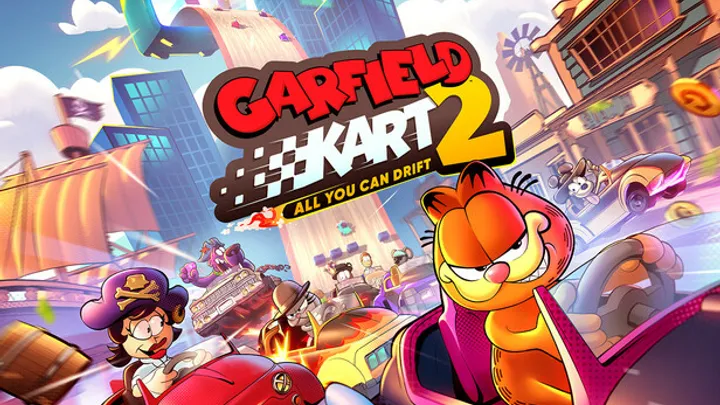
Garfield Kart 2 – All You Can Drift brings back the lasagna-loving feline and friends for another colorful ride across absurd tracks, comedic arenas, and chaotic power-ups. What was meant to be a charming kart racer for all ages has instead become a surprisingly competitive battleground dominated by one defining mechanic: drifting. While drifting exists in almost every kart racer, Garfield Kart 2 centers its entire gameplay identity around it—so much so that the balance of races, item usage, character builds, and even map design revolves almost entirely around drift mastery.
This article examines one major, specific issue within Garfield Kart 2: the over-centralization of the drift mechanic, which creates an unexpectedly unforgiving skill gap and shapes every part of high-level gameplay. Through detailed analysis of systems, race flow, track design, and game meta, we will explore how the drift-centric design both empowers skilled players and alienates casual ones. This deep, 2000-word breakdown reveals the strengths, weaknesses, and long-term implications of Garfield Kart 2’s drifting obsession.
1. How Garfield Kart 2 Builds Its Core Identity Around Drifting
Garfield Kart 2 was clearly designed with drifting as its central mechanic. From the title itself, the game sets expectations that drifting is not just optional, but the engine of progression, momentum, and performance. Unlike typical kart racers where drifting enhances gameplay, in Garfield Kart 2 it becomes the foundation upon which every track, character class, and race strategy operates.
The game grants players three levels of drift boosts, with Level 3 providing massive acceleration that can convert even sharp turns into speed-gaining opportunities. This design decision means that steering manually, slowing down for control, or racing conservatively are fundamentally non-viable approaches. Drifting is not an optional skill—it is mandatory.
This creates an unusual identity for a Garfield game, which traditionally appeals to casual gamers, children, and fans of lighthearted fun. Instead, Garfield Kart 2 becomes a mechanically demanding racer that rewards precision and punishes hesitation. The mismatch between audience expectations and gameplay complexity is where the issue begins.
2. Why the Drift Meta Creates a Steep Skill Gap
One of the most significant issues with the game is the dramatic skill gap created by drift mastery. Skilled players who understand how to chain drifts, exploit boost windows, and angle their turns with pixel-perfect control dominate races effortlessly. Meanwhile, new players suffer, spinning out, over-steering, or failing to charge meaningful boosts.
The drift system behaves differently depending on angle, duration, character weight, and even slipstream conditions. Because none of this is explained clearly in the tutorial, beginners enter the game completely unprepared. Those unfamiliar with drift-based racers feel overwhelmed and frustrated within minutes.
The most common beginner mistake is drifting too late, causing the kart to slide unpredictably. The game’s loose traction system exaggerates this, making inexperienced players feel like they are “fighting the kart” instead of controlling it.
The result is a community divided into two extremes:
- Players who master drifting and find the game exhilarating.
- Players who can’t—or don’t want to—learn the intricate drift system and abandon the game quickly.
This imbalance undermines the accessibility Garfield games are known for.
3. How Track Design Amplifies the Drift-Centric Problem
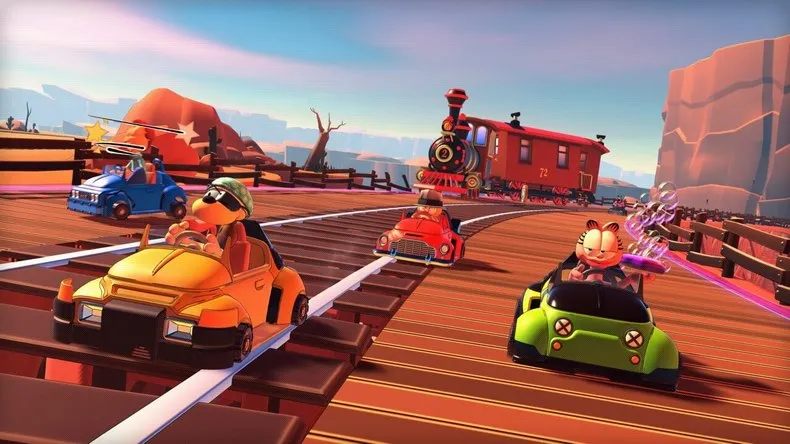
Garfield Kart 2’s track design reinforces the drift-focused gameplay loops. Most tracks feature continuous curves, figure-eight loops, and long winding slopes where drifting is necessary not only for maintaining speed but also for simply following the track correctly.
Because tracks lack long straight sections, drifting becomes the default method of movement. Players who attempt to drive normally fall drastically behind because the game design assumes drift boosts will carry racers through nearly every section of the map.
Examples of Drift-Dominant Tracks
- Cat’s Kitchen Raceway – constant circular turns demand chained drifting for entire laps.
- Castle Jon’s Spiral – a long descending corkscrew that allows experts to maintain an infinite drift.
- El Gato Desert Rally – sharp sand curves that punish hesitation with immediate slowdown.
These maps are beautifully themed, but their structure forces racing in one very specific way, reducing strategic diversity.
4. Character Classes and Drift Stats: A Balancing Nightmare
Characters in Garfield Kart 2 fall into different weight and drift categories. In theory, this should create balanced choices for all playstyles. In practice, the drift meta makes lighter, high-drift characters overwhelmingly superior.
Characters like Arlene and Odie dominate leaderboards due to their ability to enter drifts quickly and chain boosts repeatedly. Meanwhile, heavier characters such as Jon or Squeak struggle to enter drifts smoothly or sustain them in tight turns, making them inferior choices in competitive play.
This creates a meta where the cast, despite being visually diverse, becomes strategically shallow:
- Light characters: optimal.
- Medium characters: usable but suboptimal.
- Heavy characters: essentially non-competitive.
Why Heavy Characters Struggle
- Slower drift initiation.
- Wider turning radius making drift boosts harder to control.
- Lower compatibility with track layouts requiring frequent tight drifting.
This imbalance limits player expression and reduces the meaningfulness of choosing a favorite character.
5. Item Use Is Overshadowed by Drift Mastery
Items in kart racers are usually the great equalizer. However, Garfield Kart 2’s drift-dominated gameplay makes items feel secondary and sometimes irrelevant.
Because drift boosts provide massive speed advantages, speed-based items like lasagna boosts barely matter. Only disruptive items such as UFOs or pies have any real impact, and even then, skilled players can drift-boost back to full speed within seconds.
Items become reactionary tools rather than strategic weapons, diminishing their importance. Players who rely on items instead of drift technique remain at a permanent disadvantage.
Items Struggling Against Drift Speed
- Spring Trap: Too easy to avoid when drifting.
- Perfume Dash: Inferior to a Level 3 drift boost.
- Magic Wand: Slows players temporarily, but drift chains negate the penalty.
Ultimately, the item system fails to regulate unfair advantages, further widening the skill gap.
6. The Drift Boost Economy: Rewarding Excessive Execution
Garfield Kart 2 uses a “drift boost economy," meaning drifting is the primary method of gaining speed and recovering lost time. This differs from traditional racers where boosts are distributed evenly across mechanics.
Here, up to 70% of race speed comes from drift boosts. This creates a gameplay loop where:
- Every turn must be drifted.
- Every drift must be charged.
- Every boost must be chained perfectly.
This extreme emphasis removes player choice. Racers can’t opt for grip driving or alternative strategies because the game makes drifting the overwhelmingly optimal solution.
It becomes not “All You Can Drift” as the title suggests, but “Only Drift, Or Lose.”
7. How Drifting Affects Multiplayer Competitiveness
The multiplayer scene in Garfield Kart 2 mirrors the imbalance. High-level players drift in near-continuous sequences, reaching speeds casual players can’t match even with perfect item usage.
This leads to:
- Races decided in the first 10 seconds.
- Large time gaps between player positions.
- Beginners quitting matches early.
Multiplayer, which should be chaotic and fun, becomes a rigid ranking of drift proficiency. Competitive players thrive, but the majority struggle to find enjoyment, harming long-term engagement.
Common Multiplayer Complaints
- “I can never catch up.”
- “Everyone is faster even when I don’t make mistakes.”
- “Drifting feels like the only thing that matters.”
These issues reflect a deeper design imbalance rather than player error.
8. The Psychological Impact of Drift Over-Dependence
For many players, Garfield Kart 2’s drift-centric design becomes mentally taxing. The constant need to initiate drifts, maintain timing, angle boosts, and chain them together turns races into tests of endurance rather than fun experiences.
Stress Factors Introduced by the Drift Meta
- Perfection pressure: one missed drift can lose the race.
- Hand fatigue from constant drift inputs.
- Reduced variety leading to burnout.
Ironically, a game starring Garfield—a character defined by laziness and relaxation—demands relentless focus from the player.
9. Opportunities Lost Because of Drifting Dependency
Garfield Kart 2 misses several opportunities due to its imbalance. Strategic variety could be expanded if:
- Items carried more influence.
- Tracks rewarded mixed driving styles.
- Characters had more meaningful stat differences.
- Alternative mechanics existed besides drifting.
Instead, drifting overshadows creativity. The comedic and charming atmosphere becomes secondary to a mechanic that does not reflect the tone or target audience of Garfield as a franchise.
10. How Garfield Kart 2 Could Fix Drift Imbalance in Future Updates
The good news is that the drift issue can be addressed. Future patches or sequels could fix the imbalance through several changes.
Potential Fixes
- Reduce drift boost power to make straight driving viable.
- Improve tutorials for new players.
- Rebuff heavy characters with better drift entry.
- Add track sections that prohibit drifting.
- Increase item effectiveness to reduce skill disparity.
These shifts could make Garfield Kart 2 more welcoming, strategic, and humorous without eliminating drifting altogether.
Conclusion
Garfield Kart 2 – All You Can Drift is a charming, vibrant kart racer that accidentally turned itself into a competitive, drift-dominated experience. While drifting is undeniably fun and satisfying at high skill levels, the game leans too heavily on it, creating major balance issues that affect character selection, track navigation, item utility, and the multiplayer environment.
The drift-centric meta is both the game’s greatest strength and its most limiting flaw. It rewards mastery but excludes variety. It excites experts but overwhelms newcomers. Understanding and addressing this imbalance could transform Garfield Kart 2 from a niche drifting challenge into a more universally enjoyable racer.
160-Character Summary
A deep dive into Garfield Kart 2’s drift-dominated meta and how over-reliance on drifting affects balance, accessibility, characters, items, and gameplay depth.